
One of the most proven ways to protect yourself and your family is to familiarize yourself with landslide hazards in and around the area where you spend your time. The majority of landslides in the eastern US occur during prolonged, intense rainfall events when the ground is already saturated with water. There are things you can do prior to the storm events so that you know what to do when a storm is forecasted. It is important to know what to do during a storm event as well, in case you find yourself in a landslide.
Prior to Heavy Rain Events:
Heavy rain is the main trigger producing landslides and slope failures on both natural and constructed slopes. Here are some things you can do to prepare yourself and your property when heavy rain is in the forecast.
- Clean out ditches and culverts so that stormwater will flow through them freely.
- Extend your house downspouts so water is not flowing onto any fill slopes.
- Don’t drive during the heavy rains, as that is when many roads are impacted by landslides.
- Is your house is near a mountain stream or drainage, (or one of the “Where debris flows might go” areas on ALC’s landslide maps or in or downstream of a “NC Channelized Debris Flow Susceptibility Model – Areas susceptible during a storm event” on the NCGS landslide maps)? Could your driveway or access to a main road be impacted by one of these areas? If so, determine a safe place to stay during heavy storm events and go there prior to the start of the rain. Make sure this place is not in a floodplain or within an area that is modeled to be susceptible to landslides. Heed any evacuations requested by Emergency Management prior to the heavy rain. If you stay at home, be prepared to save yourself, as EMS may not be able to get to you due to impacts to roads from landslides and flooding.
- Visit our page on Landslide Maps of WNC for more information about the landslide maps available for parts of Haywood County and Jackson Counties. For other counties, check the County’s GIS webpage or the NC Geological Survey’s Landslide Hazard Data Viewer.
During Heavy Rain Events:
- During intense storm events, keep an eye out for a sudden rise in water level, increased sedimentation, sounds of trees and boulders falling or crashing together. Move to higher ground away from the stream drainage, if it is safe to do so. If you are in a single-story house, move to an interior room with minimal furniture or climb onto a kitchen counter, desk, or sturdy table and hold on (USGS “Landslide Safety” flyer Version 1.3, October 24, 2024). If there is a second story to your home, go upstairs. Move toward the downhill side of the house. The landslide could push through windows on the uphill side.
- If your home is not near a stream or drainage or in a modeled potential debris flow path, do not go outdoors to investigate sounds. Many people in WNC have been swept away by debris flows outside of their homes, when the homes themselves were not impacted.
When deciding where to live
There are some key steps that landowners can take to protect themselves and their property investments from landslide hazards pre-construction, during construction and post-construction.
Pre-Construction:
Before building on a site, it is important that you are familiar with the characteristics of the land. Landslides can happen on natural slopes or slopes that have been modified by human activity (fills, cuts, waste piles). They tend to occur on slope angles steeper than 22 degrees (40% slopes). Since 1990, over 70% of the landslides cataloged by the NC Geological Survey and ALC have been on modified slopes. It is important to determine if modified slopes exist on your property and if they are stable.
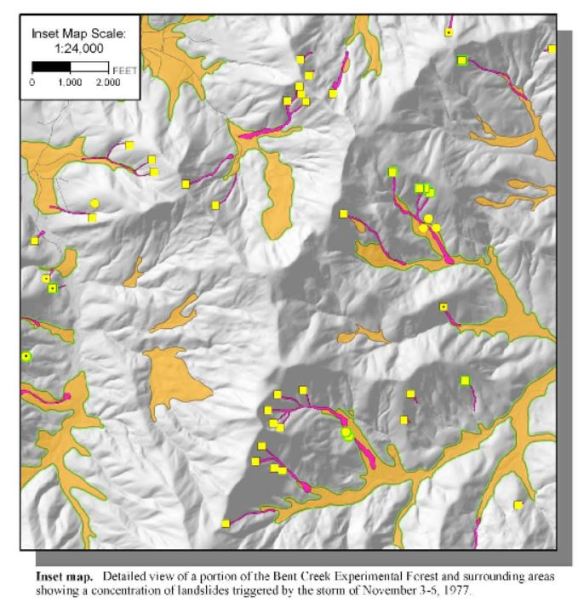
One of the best ways to protect yourself from naturally occurring landslides is to avoid building in or modifying areas in which they may start or impact. For certain counties and watersheds, there are landslide hazard maps available that show where landslides and landslide deposits have been mapped, where landslides might start during heavy rains, and the areas that might be affected during these heavy rains.
Excerpt from Buncombe County Slope Movement & Slope Movement Deposits Map
However, these maps are not intended to replace on-site evaluations and determinations of landslide activity. They are intended to alert owners that there is a potential for landslide hazards to exist on a site and/or within an area which should be investigated further. Ultimately, If you are concerned about your property being in a potential landslide zone, we recommend that you contact us for a site specific property evaluation.
During Construction on Steep Slopes:
Water is one of the biggest triggers of landslides. When soils on steep slopes get over saturated, they lose their strength and are prone to failure.
- Try to maintain water flowing into its natural drainage ways. If this is not possible, ensure proper storm water runoff measures are in place so that water does not back up behind culverts, pond, or flow onto constructed fill slopes. You may want to hire a storm water consultant to design preventative measures.
- Seat your foundation on in-place soil or bedrock, this includes the foundation for elevated decks
- Properly design, construct, and maintain any cut or fill slopes and drainage near them. We recommend you hire a geotechnical engineer to design fill slopes or cut slopes.
After construction:
- Maintain ditches and culverts. Blocked stormwater runoff pathways can lead to water running over slopes that weren’t designed for it. This can lead to over-saturation of the soil and failure.
- Keep an eye out for cracks along the edges of driveways or tops of fill slopes. Look for any signs of bending or leaning of deck posts. Look for cracking in retaining walls or foundations. If you see any of these signs, contact us for a site specific property evaluation.


 Appalachian Landslide Consultants, PLLC